Origin
We thought, from the beginning, that Lustelumenya Written Language should have, not merely its own Letters, but its own Sounds. And the means of representing the sounds (and more on that later!) came to us by means of a Children's book on the subject of.....well, not to put too fine a point on it, the subject of intelligence or, if you will espionage, or, to avoid finery as much as possibly spying
This was approx. 1979. Which, I suppose, explains everything.....
Inside this book, there was a section of different means of representing text using symbols. This is, of course, different to encoding a message; but rather, repenting Roman letters by different symbols.
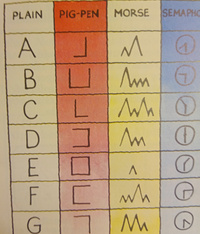
It will be more interesting to look up "Pig Pen Code" yourself than to follow links from here!
We had just begun to learn hexadecimal and binary numbers (it was 1983, and Computing Skills were considered important enough to touch at Primary School. The fact that there were no, you know, actual Computers at our primary school was considered less important than the Mathematics.
Learning to count! From 0 to 15! Using only 4 'symbols' ("presence" meant "1", and "absence" means "0") helped us to understand that the four symbols that were contained withing a square-shape could represent or be represented by Nos. 0-15!
Combined with what we had already learned about Pig-Pen code, it gave us a clue: (Please Note: "LuLa" ['Lustelumenya Laguage'] is a short-code for "Pig Pen text". The name 'Lustelumenya' had not yet been discussed. Means of communication were more urgent than national identity :) )
| lula | Bin. | Hex. |
|---|---|---|
|
0000 | 0 |
m |
0001 | 1 |
q |
0010 | 2 |
r |
0011 | 3 |
p |
0100 | 4 |
t |
0101 | 5 |
h |
0110 | 6 |
s |
0111 | 7 |
f |
1000 | 8 |
k |
1001 | 9 |
i
andl
, orn
andd
. Orz
andl
(etc. etc.)THE DOTTED LINES ARE HERE TO HELP US WHILST BEGINNING TO LEARN.
i |
1010 | a |
n |
1011 | b |
l |
1100 | c |
d |
1101 | d |
z |
1110 | e |
w |
1111 | f |
IMPORTANT NOTE ON "DOTTED LINES"
(This will be repeated and repeated, because it's important)
i n l d z w
The 6 characters are "written" or otherwise shown with the Central Dotten Line. Please note that the Dotted Line is intended ONLY to make it clear which of the 6 characters is being displayed; without it, the two "vertical bars" and the two "horizontal bars" could be mixed up and confusing.So!! Please remember!! The little dots are for convenience at "educational level" (i.e. Here!!)
(and, you are encouraged to use your imagination to come up with your own idea to identify the Point of Reference. Much later we will discuss handwriting and complex characters, and share some ideas of ours. But now and always, your ideas are welcomed.....
Think of it as Imaginative Handwriting. Or opportunities for Fonts. )
It is probably worth bearing in mind that we were learning about programming and computers; but no-one had actually seen a working computer at this point. Not the teacher, nor the pupils; I don't even know whether or not anyone's parents worked with computers. The most advanced computer in the Midlands at that time would have been something like the PDP-10(1). This would explain why we told that one byte was 7 bits; and since there were pocket calculators available at this point, we were familiar with the idea of a "7-bit display"
(of course, we had, so far, "used" only 4 bits!! Which means, we had 3 left over!!)
(1). It could also have been that there was a Datapoint 2200 in the area. Even a CP/M. But not at anyone's home in 1982.
